


Hearing safety
Hearing Protection Education Center
Hearing loss is permanent — and often preventable
Whether you're at the shooting range, on a construction site, in a manufacturing facility, at a concert, or operating outdoor equipment, noise exposure is one of the most common — and most underestimated — risks to long-term health. At Magna Lens®, we believe education is central to hearing conservation.
Understanding dangerous noise levels
The decibel (dB) scale is logarithmic — meaning every small increase represents a dramatic jump in sound energy. Understanding where everyday and high-risk sounds fall on this scale is the first step to protecting your hearing.
Common Noise Levels
| Source | Approximate Level |
|---|---|
| Normal conversation | 60 dB |
| Lawnmower | 90 dB |
| Motorcycle | 95 – 100 dB |
| Circular saw | 100 – 110 dB |
| Indoor shooting range | 140 – 165 dB |
| 9 mm pistol | ~160 dB |
NIOSH recommends 85 dB as the threshold above which sustained exposure puts your hearing at risk.
Safe exposure time drops faster than most people realize
Because the decibel scale is logarithmic, every 3 dB increase doubles the sound energy reaching your ears — which means safe exposure time drops dramatically as volume rises. Firearms and other impulse sounds can cause instantaneous, permanent damage with a single exposure.
Safe Daily Exposure Times
| Sound Level | Maximum Safe Exposure |
|---|---|
| 85 dB | 8 hours |
| 88 dB | 4 hours |
| 91 dB | 2 hours |
| 94 dB | 1 hour |
| 100 dB | 15 minutes |
| 110 dB | Less than 2 minutes |
Why earmuffs alone may not protect you
Because earmuffs surround the entire outer ear, they can attenuate sound reaching the ear through pathways that earplugs alone do not cover, including some sound transmitted through the tissues and bony structures surrounding the ear.
Earmuff performance is expressed as a Noise Reduction Rating (NRR) - a laboratory-derived value that may not reflect the protection achieved in real-world use. One important reason is interference from eyewear: traditional eyewear temples pass between the head and earmuff cushion, disrupting the acoustic seal. Research has found attenuation losses of up to 17 dB with certain eyewear-and-earmuff combinations, making eyewear interference an important but frequently overlooked source of compromised hearing protection. (References 1, 2, 3, 4, and 5.)
Why preserving your earmuff NRR matters
Up to 17 dB
That's how much protection you can lose from a single broken earmuff seal.
All you need is a tiny gap in your earmuff seal to dramatically reduce sound attenuation. Additionally, because dB is logarithmic, losing 17 dB doesn't mean losing "a little." An earmuff rated NRR 25 with a compromised seal can perform dramatically worse than the label suggests — and in some cases this translates into a 10-fold difference in allowed sound exposure time.
Indoor shooting ranges: a high-risk environment
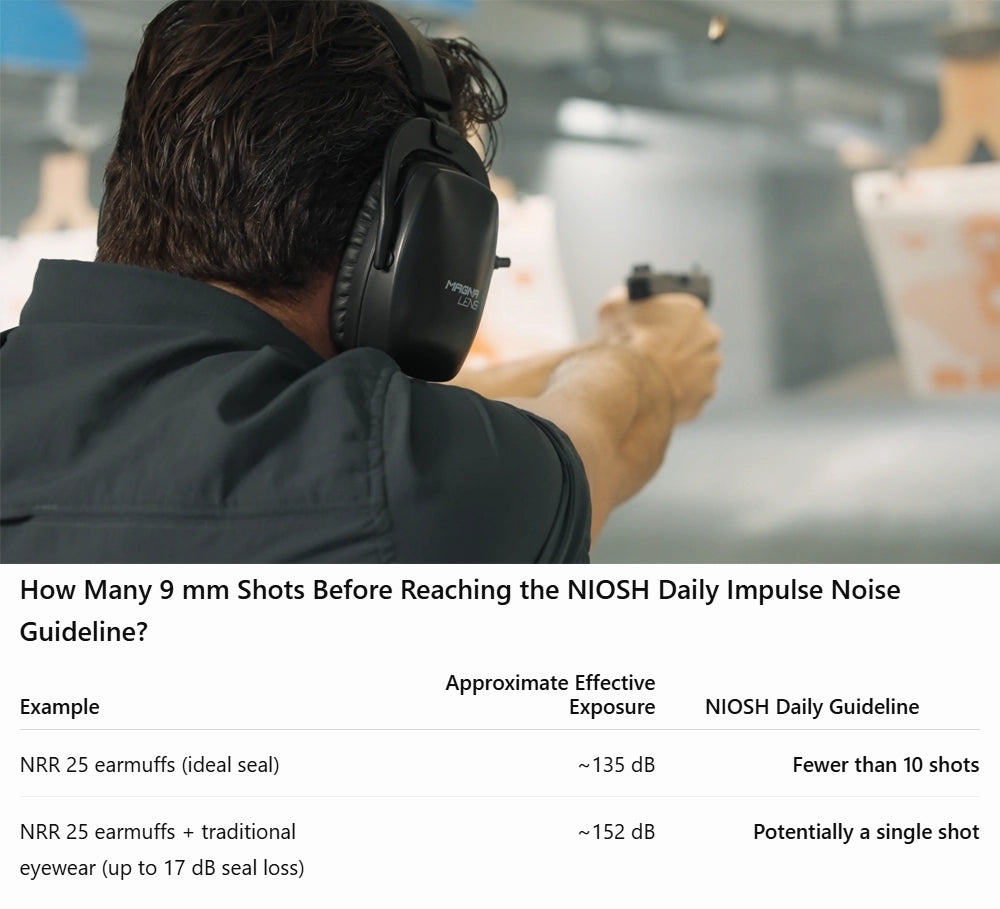
Indoor shooting ranges are among the loudest recreational environments most people will ever experience. A typical 9 mm handgun produces an impulse noise of approximately 160 dB at the muzzle. Under ideal laboratory conditions, an earmuff with a Noise Reduction Rating (NRR) of 25 may reduce this to an effective exposure of approximately 135 dB.
According to NIOSH guidance for impulse noise exposure, a person should be exposed to no more than approximately 10 impulses at 130 dB within a 24-hour period. In this example, a shooter wearing properly fitted NRR 25 earmuffs could approach their recommended daily impulse noise exposure after fewer than 10 rounds fired indoors.
Now consider what happens when traditional safety glasses are worn beneath the earmuff cushions. Studies have shown that eyewear can reduce the effective attenuation of earmuffs by up to 17 dB by creating a small gap in the seal. In this example, the effective exposure could increase to approximately 152 dB—an enormous increase in sound energy. Under those conditions, a shooter could exceed their recommended daily impulse noise exposure with a single shot.
How Many 9 mm Shots Before Reaching the NIOSH Daily Impulse Noise Guideline?
| Example | Approximate Effective Exposure | NIOSH Daily Guideline |
|---|---|---|
| NRR 25 earmuffs (ideal seal) | ~135 dB | Fewer than 10 shots |
| NRR 25 earmuffs + traditional eyewear (up to 17 dB seal loss) | ~152 dB | Potentially a single shot |
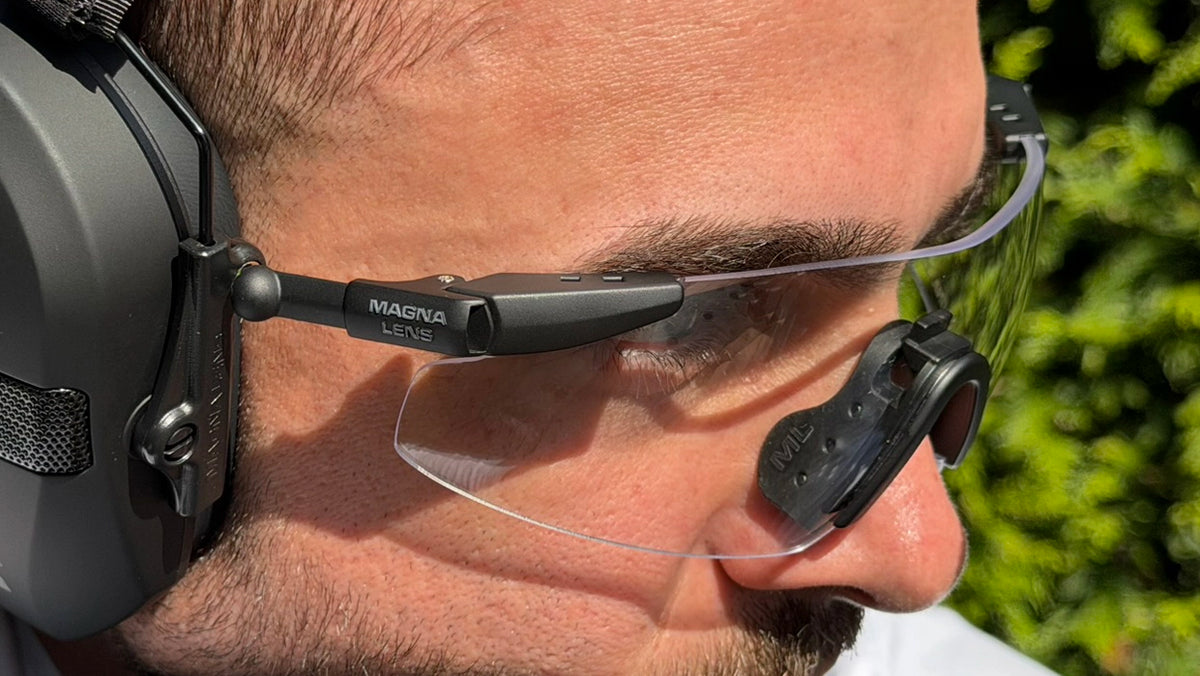
Magna Lens was developed to help address this often-overlooked problem. By eliminating traditional eyewear temples beneath the earmuff cushions, the Magna Lens magnetic system helps preserve the earmuff seal, allowing the hearing protection to perform more closely to its intended capability.
To stay protected in high-noise environments, we recommend:
- High-quality earmuffs with a strong NRR rating
- Properly inserted foam earplugs
- Double protection — earmuffs and earplugs together
- Eyewear that doesn't break the earmuff seal
- Periodic breaks to reduce cumulative exposure
The importance of double hearing protection
In high-noise environments — indoor ranges, industrial sites, aviation, motorsports — combining earmuffs and foam earplugs provides substantially greater attenuation than either method alone.
While earplugs are not as effective as earmuffs in reducing bone conduction of sound across the skull, they can reduce sound entering the ear canal directly. Earmuffs add an external barrier that further blocks airborne, bone conducted, and reflected sound. Together they cover gaps that single-layer protection cannot.
Proper foam earplug insertion
One of the biggest problems with earplugs is that most people do not insert them correctly — and incorrectly inserted plugs can lose most of their protective value. Follow these four steps:
- Roll the plug tightlyCompress it between your fingers into a thin, crease-free cylinder.
- Reach over your headPull the top of the ear upward and outward to straighten the ear canal.
- Insert deeplySlide the plug far enough into the canal that most of it sits inside the ear.
- Hold and let it expandKeep light pressure for several seconds while the foam expands to seal the canal.
Selecting the right hearing protection
The right hearing protection depends on your environment and how you use it. Consider:
- NRR rating — a useful starting point, but real-world protection depends on proper fit and use
- Proper fit — a secure, comfortable seal is essential to achieving effective hearing protection
- Environment — choose hearing protection appropriate for your activities, whether at indoor shooting ranges, construction sites, manufacturing facilities, hunting, using power tools, aviation, or motorsports
- Eyewear compatibility — traditional eyewear temples can compromise the earmuff seal and reduce real-world attenuation
- Wear time — hearing protection only works when it's worn consistently and correctly
- Situational Awareness — electronic hearing protection can amplify important ambient sounds and speech while automatically suppressing hazardous impulse noise, making it ideal for shooting sports, hunting, industrial workplaces, and other environments where communication and awareness are essential.
Hearing loss affects far more than your ears
Noise-induced hearing loss affects far more than just your ears. Over time it can impact:
- Communication with family, friends, and coworkers
- Situational awareness in everyday environments
- Sleep quality and stress levels
- Concentration and cognitive performance
- Relationships and overall wellbeing
Did you know?
Untreated hearing loss has been identified as one of the largest potentially modifiable risk factors for dementia in midlife.
Protecting your hearing today may benefit not only your ears but also your long-term cognitive health.
How Magna Lens® helps solve this problem
Magna Lens® was developed specifically to address the eyewear-earmuff seal problem. Our patented magnetic connection system integrates directly with compatible earmuffs.
- Helps preserve earmuff seal against head to maintain earmuff noise attenuation
- Eliminates pinching head pain for all-day comfort
- Improved productivity and PPE compliance
- Lenses with outstanding optical quality
- Compatibility with top brands of earmuffs
- Prescription lens options available
- Adjustable for all face and head sizes
Magna Lens is a USA based family owned and operated business. The Magna Lens team is passionate about safety and performance, and above all, we are deeply passionate about our customers.